
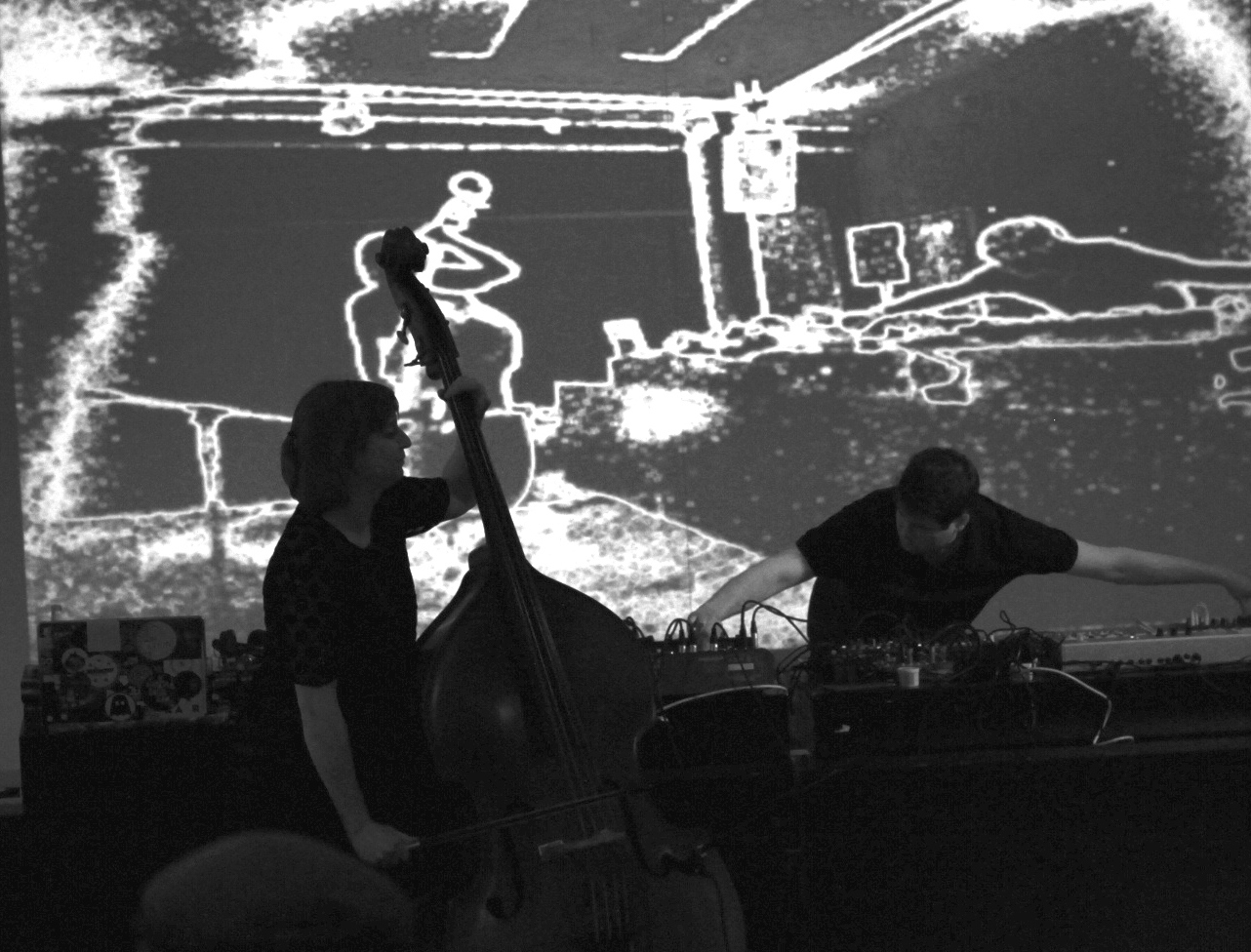
At the crossroads of bass, improvised music and DIY: meet Parisian duo Haxo on the release of their debut album Nuit.
Among the many friendly and musical encounters I’ve had on the Paris scene over the last ten years, I’ve had the undeniable pleasure of crossing paths with Jeanne and Aurélien, aka Haxo. They are true activists, passionate about all forms of sound, relentless proponents of mixing genres and advocates of a certain form of collective and iconoclastic autonomy as artistic horizons. For their own label, Syrinx Music, they have since reached a milestone in their shared sonic journey with the release of their first full-length album, Nuit, on 4 February.
By chance or pure karma, on the same day I left the flat I was sharing with a friend on the street of the same name (Haxo, again), not far from where they will be performing very soon at their release party on 6 March at the Cirque Électrique near Porte des Lilas. This was an opportunity to discuss with them the many facets of their music, which is difficult to pigeonhole into a single genre. An aesthetic of collision and letting go.
Tim Karbon for CxC:
Hello Jeanne and Aurélien, we are delighted to have the opportunity to chat with you about the release of your first album, Nuit, which came out on 4 February. First of all, could you tell us a bit more about your various individual and collective musical activities?
Jeanne:
Hi! I’m a double bass player and improviser, and I play in several bands: in a duo with guitarist Triinu under the name Valra, in a trio with Camille d’Arc (sound poetry) and Florent Delaboudinière (modular synths) under the name Forêt Fantôme, and with Haxo, of course. I released my first solo double bass album, Immersion Libre, on the MMLI label in December 2024.
In spring 2026, I will release a second solo album on the Les Disques Omnison label, on which I play double bass and electric bass. I trained in classical music and continue to practise it: I sing in a vocal ensemble called Miscellanées, and I sometimes play in a symphony orchestra.
Background:
Hello! For my part, I was initially active in the bass music scene from the early 2010s, as a DJ under the alias Background, but also as the head of the web media SeekSickSound, the associated parties and collective, and as a member of The Bass Society crew, focusing more on grime, dubstep, garage and jungle. With SSS and then The Bass Society, I have also been a resident DJ on Rinse France since the radio station launched in 2014.
That said, I’ve always been very attracted to noise, experimental and improvised music, which I discovered long before bass music: beyond Haxo and Syrinx, which we can talk about later, this is what has driven me to create several more live and experimental projects/groups in recent years, such as Ritaline Tsouko, Lutèce162 and Magnetar. All of this has led me to focus more on solo work today: I released my first track last summer on the Scottish label Bricolage.
When did you start composing and playing music together under the alias Haxo? Did you have other instrumental projects going on before the duo was formed?
Background:
Technically, Haxo was born in 2016, during an improvisation festival organised at Mains d’œuvres (Saint-Ouen), where we were invited to perform. We had already started improvising together at home, but this was our first live performance in front of an audience. After the show, I talked about it to bahnhof::zoo, an artist who was running a footwork/noise/experimental label called NIDALI Records at the time. He thought the idea of mixing machines and double bass was really interesting and suggested we make an EP.
That’s how we went from improvisation to the idea of structuring songs: we immediately preferred to compose real songs for the EP rather than releasing excerpts from jams. When we played live again for the release party for this EP, called Freitags Variété, which came out in 2017, we structured the live show around these compositions and started writing what would become Nuit.
Jeanne:
Personally, it was my first instrumental project that allowed me to really express myself on stage with the double bass. At the time, I was still at the conservatory, and even though I had always practised improvisation and a freer style of playing than the classical repertoire, I wasn’t yet performing on stage with the instrument. Haxo was liberating.
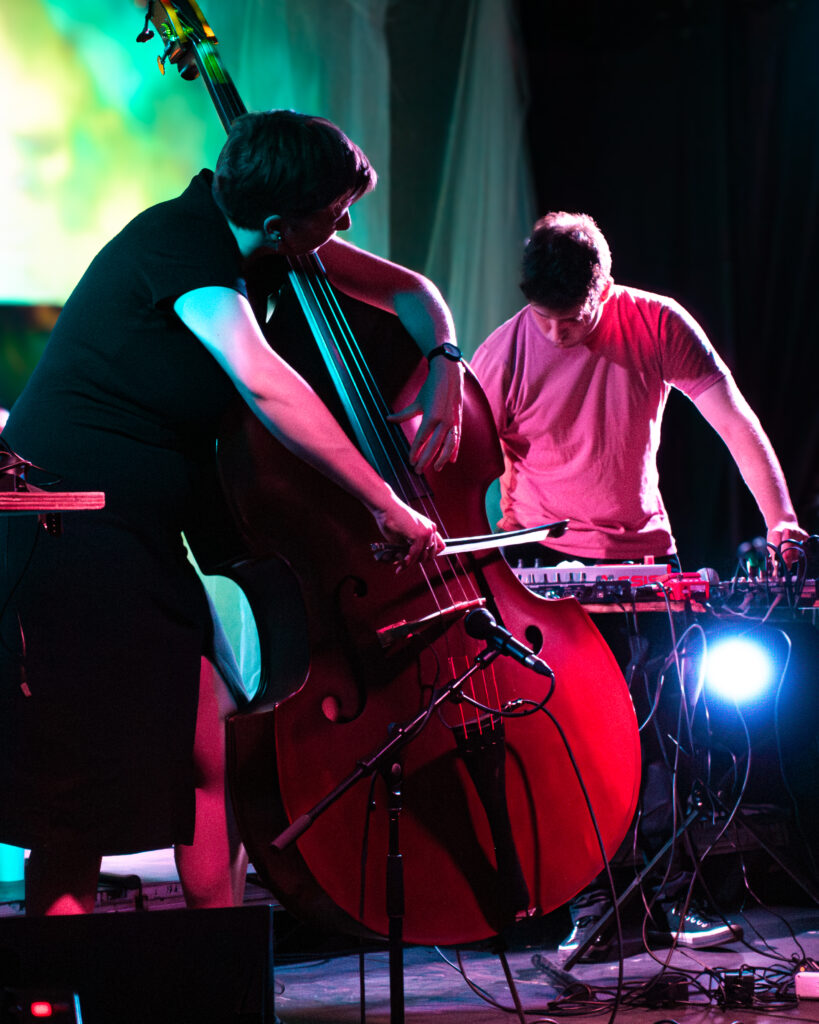
After listening to your album several times, it seems clear to me that you leave plenty of room for sound experimentation and improvisation in the production of your tracks, whether instrumental or through modulation effects. Could you tell me more about the composition process?
Jeanne:
Our playing has evolved since Haxo’s beginnings, as has our listening practice. We have always been curious about a wide variety of musical styles, but over the decade since the duo was formed, we have increasingly frequented the experimental and improvisational music scenes, which is obviously reflected in our playing. I think you can also hear that our influences are diverse: it’s not entirely club music, nor is it entirely improvised music, since the pieces have a fixed form and recurring melodies, and it’s not a classic song form either. It’s a bit of everything at once, to varying degrees.
Background:
I think we all oscillate between our taste for improvisation and experimentation on the one hand, and our interest in more pop-oriented music on the other, but which deviates from the norm. I believe that’s what’s at the heart of writing songs: we always start with improvisation sessions, but we usually find structures, melodies and beats fairly quickly that we can work with and arrange to form songs. I think part of the reason Nuit took so long to come together was because we wanted to find a balance between all these different tendencies: we started writing the oldest songs (‘Park’, ‘Post’) in 2017, at a time when our live shows were really focused on our compositions, but after creating Syrinx, we started playing more or less completely improvised live shows again. The idea was to reflect all of that in the album: there are written structures, but also, indeed, improvised pieces or things that came about accidentally.
Live music techniques seem to strongly influence the sound of your album. How would you define the connection you establish between studio production and concert format in your sound approach? And what tools and setups do you use to bring this dialogue to life?
Jeanne:
For me, it’s quite simple: my live and recording set-up is the same. The difficulty in recording lies in capturing the sounds of an acoustic instrument, designed to be played live and in orchestral forms, not solo. It’s quite a thankless task to record the double bass, but you eventually get there. I try to approach music as sincerely and spontaneously as possible, which is fairly easy for me live, but much more difficult when recording. So I force myself not to demand too much precision from myself, not to dwell endlessly on details, to focus on the overall mood of the piece and the emotion of the melody line, how it fits into the electronic backdrop created by Background. To put it more clearly: with my instrument, it’s very easy to want to constantly re-record to make it more accurate, rework a bow stroke, or, in the case of repetitive motifs, loop the best take to keep only that one, but that’s not what I want with Haxo, because I want our studio sound to reflect the momentum we have live.
Background:
As I said earlier, most of Nuit‘s songs were written with live performances in mind: the idea was often simply to have new songs to play at concerts! It was then, by playing them from concert to concert, always leaving room for improvisation, that they were refined. I think we consider the tracks to be constantly evolving rather than finished, and we don’t actually do much work in the studio, at least not in the role of ‘producer’. It’s really only when we’re ready to release a track, for the album or for our contributions to compilations, that we sit down to record and mix it, but that doesn’t mean the process stops there: some tracks have continued to evolve afterwards. To answer the second part of your question, on a more individual level, I work mainly with hardware: synths, samplers, drum machines, and effects. It’s not so much a question of aesthetics as a preference for playing: I started out as a pianist, and I’ve always felt more comfortable improvising on a keyboard or faders than behind a computer screen. I also use very few loops, and I think that plays a big part in the sound of the project and in the interaction with the double bass: it opens up a lot of space and freedom in the playing.
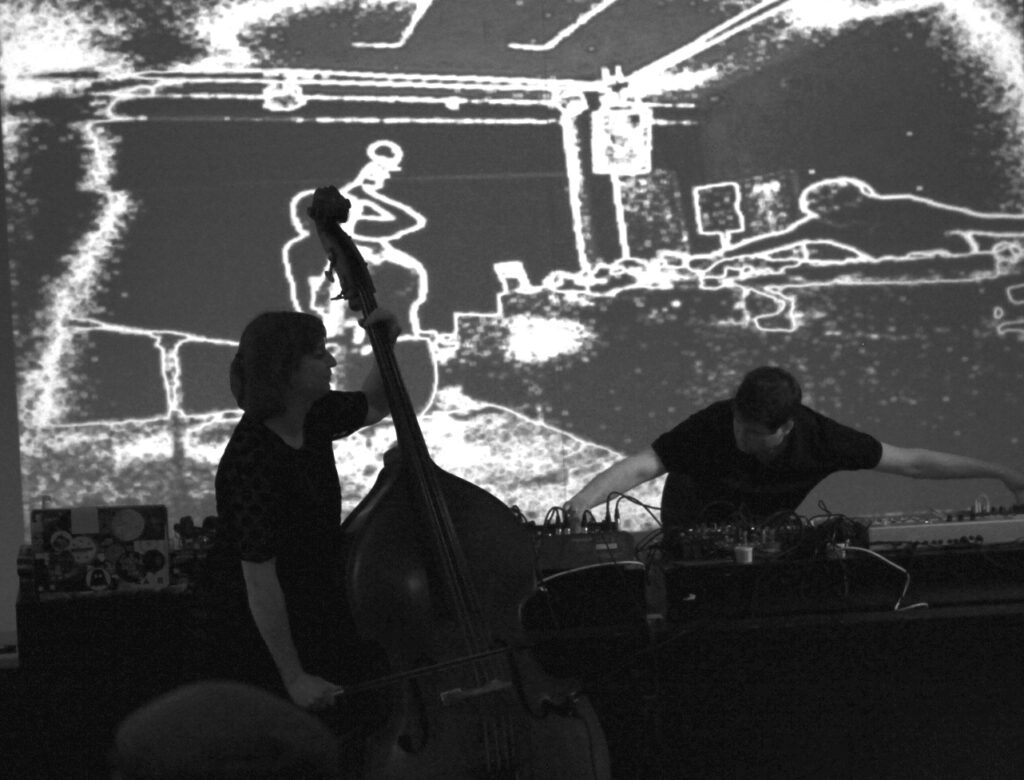
What prompted you to set up the Syrinx Music collective and label, and what artistic aspirations do you have for it in the long term?
Background:
Syrinx was born over drinks with Paul, aka No3sis, in 2020. We knew each other through mutual friends, but it was the first time the three of us had met up. All three of us had already been thinking about starting our own label, and we left the bar with the idea of starting one together: the idea was immediately to create a 100% DIY platform that would bridge the gap between experimental and electronic music, music and visual arts, and of course to promote artists whose music and approach we love. The ideas of collective and scene are super important to us: it was also an important point from the start of the label, and it still is. I think that’s essentially what we’re aiming for in the long term: to continue to defend this spirit of independence, DIY and collective.
Jeanne:
We felt that there was a lack of connection between electronic club music and experimental sound. Syrinx seeks to fill this gap, to showcase music that navigates between these influences. Many artists who have released music on Syrinx have told us that they couldn’t see any other label that could have released what they did. In these cases, we feel that we are really useful to the music scene, and that’s what we’re looking for: to promote the collective and the creation of an ecosystem between different artists from different scenes.
I know that you both share a particular interest in the physical formats of music. How important is the editorial and material dimension to you as collectors, label managers and artists?
Jeanne:
The physical format makes this intangible art tangible. It also allows us to distribute visuals that we have created ourselves to add an extra artistic dimension to the music. I know that many of the people who buy our CD don’t even have the means to listen to it at home. But it’s a way of supporting our work, and it’s also a way of displaying it in your home, talking about it with friends who come over and ask what it is, remembering that it exists when you walk past it or when you’re packing your moving boxes. I find the symbolic dimension very powerful, more important than the purely auditory aspect. And I believe that given the times we live in, we need to bring poetry and symbolism into our lives.
Background:
It’s both something important to us and something we haven’t really thought about much. It goes back to our individual backgrounds: personally, I grew up with CDs, which I started collecting in the early 2000s, then later added vinyls and cassettes, so physical media have a special place in my heart. That said, I have nothing against digital: most of our releases are digital, which offers a flexibility that I really appreciate. But I’ve always intuitively felt that certain releases lend themselves very well to tape or CD format, for aesthetic or structural reasons: that’s always what motivates our physical releases. Take Nuit, for example: we really designed it with the idea of releasing it on CD, with its nine-track structure and a bit of an interlude in the middle.
At a time when alternative art scenes, at least in France, seem to be increasingly fragmented and disjointed, and when public authorities, capital and the media are working hand in hand to promote a culture that is ‘respectable’ in the eyes of the State, how do you see the present and future of experimental, electronic and night-time music?
Jeanne:
Honestly, I am afraid, seeing it from the inside, because part of my work takes place not on stage, but in the institutional parts of musical culture and nightlife. But it is not a paralysing fear: it is a fear that drives me to action and tells me that we must hold our ground at all costs, now more than ever. We must make other voices heard, be uncompromising about our values, believe and show, through action, that an alternative is possible. I hate the way we confuse art and communication, artistic production and promotional content, trusting an artist not for their work but for the number of likes they get on fascist digital platforms. For me, it is a serious political mistake to get caught up in these games. Using communication channels to make alternative voices heard is one thing. Bending over backwards to seduce algorithms is another. The line is thin, but the distinction is crucial, and I find that we are losing it too often today. It’s a vast subject, but what we seek to defend, and will always continue to defend, is the existence of a multitude of alternative and necessary voices, even if they cannot be categorised. We should not seek ‘buzz’ but organic growth. It takes time to truly connect, but it is the only way to stand together, and together we are strong.
Background:
This is a crucial question, and I won’t pretend to have a definitive answer. I am a very pragmatic person, but also fundamentally optimistic. If I look at the current situation and try to be objective, it’s rather depressing: I feel that, beyond the economic situation of the cultural world, the primacy of social media and algorithms really works against our scenes. The initial idea behind social media was to create connections, contacts, in short, a sense of community, but I think we’re now in a very different situation where, to exaggerate slightly, the idea is to shine individually by crushing others in the algorithm, even if it means accepting all the algorithm’s codes. This is something we have always sought to avoid, even if it means having less visibility, because we believe that the answer lies elsewhere – and here I return to my optimism: in the collective, in the idea of the stage, precisely, and in DIY (which does not mean ‘done on the fly’), in small structures, independent projects, cellars, rooms at the back of a bar, deviance from the norm, always to create social ties, sharing energies and creativity. This is what we have always defended, and will continue to defend, because even if it takes a lot of energy, this is where we find joy and meaning – and I believe that is truly essential.
Thank you very much for accepting my invitation for this interview. Finally, could you tell me about any future projects and events concerning Haxo and Syrinx Music?
Background:
A big thank you to you! Next up is our release party on 6 March at the Anti-Club du Cirque Électrique, with a line-up we’re very excited about: the poetry/modular duo Patricia Favreau & Paul Michel, the minimalist rock of Triinu and the noise of Wysocka. Next up, we already have a bunch of releases lined up for this year on Syrinx, including the return of several artists who have previously released on the label, starting very soon with Denver’s Little Brother.
Jeanne:
On a personal note, I’m releasing a solo album in March, accompanied by a live tour in England that same month.
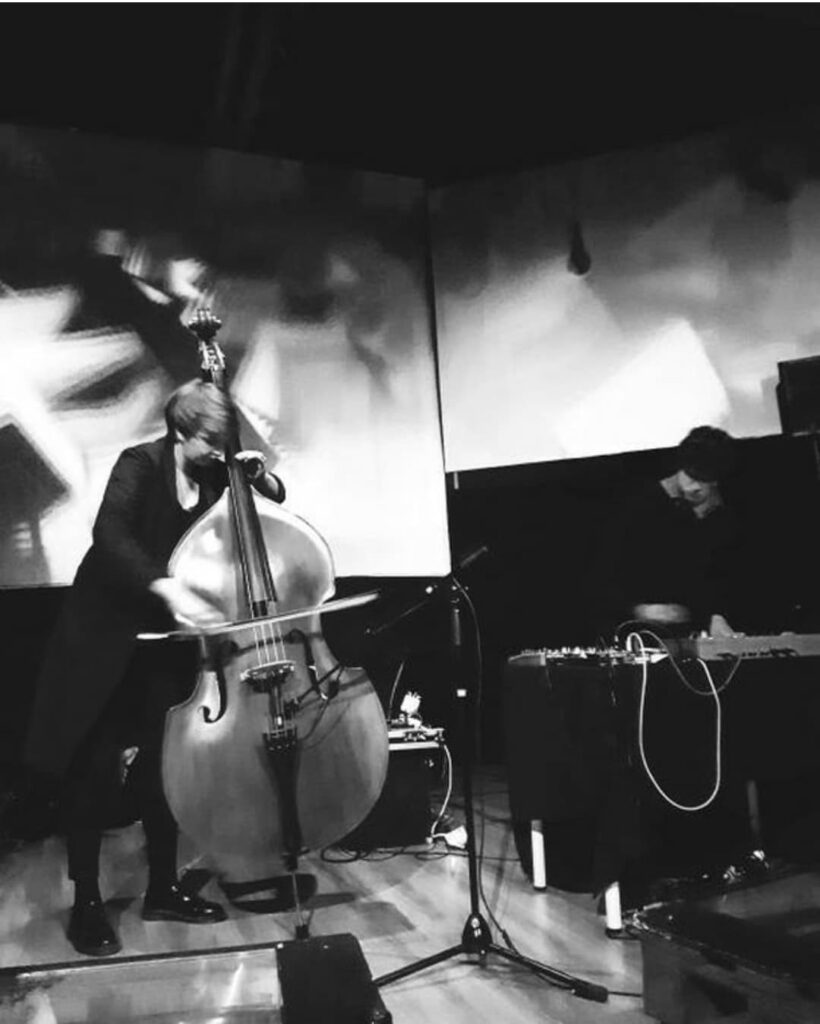
You can now listen to and/or purchase the CD version of Nuit, Haxo’s first album released on their label Syrinx Music, on Bandcamp.
They will present the album live at their release party at the Anti Club at Cirque Électrique on 6 March.
